State of Cyprus Gas
2026 Annual Report
Where Cyprus's offshore gas industry actually stands: what has been found, what has been sanctioned, how the gas will reach markets, and what happens next. Compiled from government filings, operator disclosures and the OilCyprus dataset. Published 22 August 2026.
Executive Summary
2026 is the year Cyprus's gas sector moved from discovery to development. Fifteen years after Aphrodite opened the province, all three of the EEZ's resource hubs now sit on sanctioned or near-sanctioned development tracks: the Cronos plan was approved in May, the Block 10 fields were declared commercial in June, and Aphrodite — in FEED since December 2025 — secured a 15-year Egyptian offtake term sheet in April.
The resource base stands at an official ~17–18 tcf across 6 commercial-scale fields. Every sanctioned export route runs through Egypt: Cronos to the Zohr facilities and Damietta LNG, Aphrodite by new-build pipeline to Port Said. No Cypriot molecule has yet been produced; on current targets, the first arrives in 2028 from Cronos.
The decisive variables for the next twelve months are three final investment decisions (Cronos, Aphrodite, then Block 10 around 2029) and one drill bit — the late-2026 Pegasus appraisal that will size the largest resource concentration in Cypriot waters.
The Resource Base
| Field | Block | Discovered | Operator | Est. resources | Status |
|---|---|---|---|---|---|
| Aphrodite | Block 12 | 2011 | Chevron | 2.9 tcf | development |
| Calypso | Block 6 | 2018 | Eni | under appraisal | discovered |
| Glaucus | Block 10 | 2019 | ExxonMobil | 3.7 GIIP tcf | development |
| Cronos | Block 6 | 2022 | Eni | 3.1 GIIP tcf | development |
| Zeus | Block 6 | 2022 | Eni | 2-3 tcf | discovered |
| Pegasus | Block 10 | 2025 | ExxonMobil | under appraisal | development |
Per-field figures mix recoverable, contingent (2C) and gas-initially-in-place categories as reported by operators and are not strictly additive. The ~17–18 tcf headline is the Republic of Cyprus's estimate (a government figure given in ministerial statements since February 2024; no published document states it). No document states a joint figure for the Block 10 fields Glaucus and Pegasus; the figures published for each, and their disagreement, are set out on the Glaucus resource-potential page.
Updated October 2026 · Sources: NSAI, Feb 2026 (sanctioned phase)primary, Cyprus MECI, operator disclosures
Three Development Tracks
Every commercial resource in the EEZ now belongs to one of three development systems, each at a different stage and each with its own export logic.
Cronos (Block 6)
Eni/TotalEnergies, 3.1 tcf GIIP. Development plan approved 19 May 2026; subsea tie-back to Zohr, liquefaction at Damietta LNG. First gas ~2028 — on track to be Cyprus's first producing field. Zeus and Calypso are future tie-in candidates.
Aphrodite (Block 12)
Chevron/Shell/NewMed, 2.9 tcf (2C contingent). FEED since December 2025; 15-year EGAS term sheet (April 2026) for the full ~700 mmcf/d via a new ~$2 bn pipeline to Port Said. FID late 2026–2027, first gas ~2030–31.
Block 10 hub (Glaucus + Pegasus)
ExxonMobil/QatarEnergy — the largest concentration in Cypriot waters, with no published figure for the two fields together; the ministry's written estimate for Glaucus alone is 3.7 tcf GIIP. Declaration of Commercial Discovery 30 June 2026; appraisal late 2026, FID ~2029, production ~2033. Export concept (LNG-led) to be fixed at FID.
Export Routes: Everything Runs Through Egypt
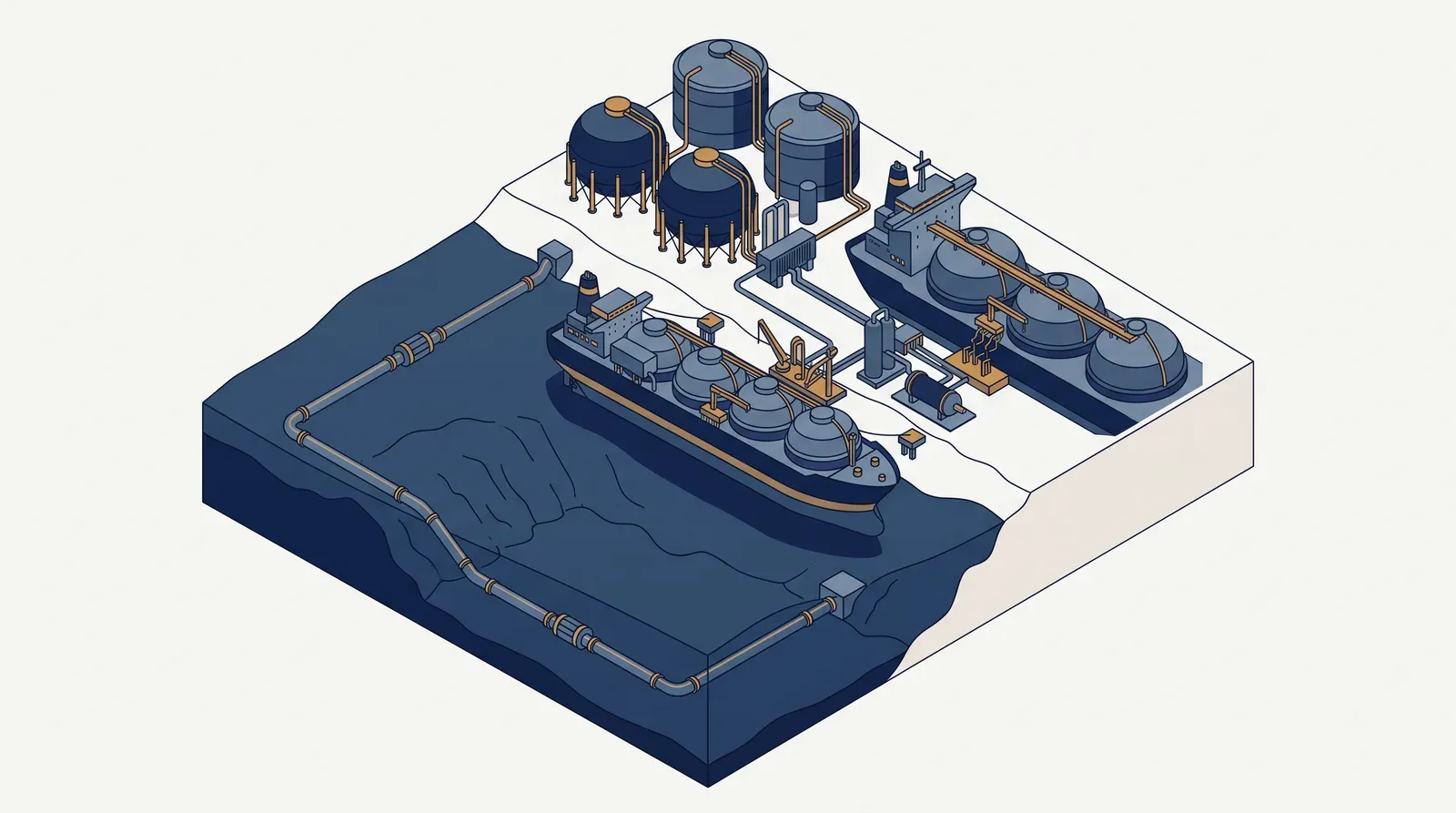
The defining commercial fact of 2026 is that both sanctioned export schemes are Egyptian. Cronos gas will be processed at the existing Zohr facilities and liquefied at Damietta LNG; Aphrodite gas will flow through a purpose-built subsea line to Port Said. Egypt's appetite is structural — declining domestic output has turned it from LNG exporter to net importer — and it has now contracted Cypriot, Israeli (Leviathan's $35 bn deal) and its own molecules around the same liquefaction hubs.
The once-headline EastMed pipeline to Greece remains dormant: technically challenging, commercially unanchored and superseded by the Egyptian route. A Cyprus-based LNG option resurfaces periodically for Block 10, whose scale could justify standalone infrastructure — one of the genuinely open questions heading into the ~2029 FID.
Licensing State of Play
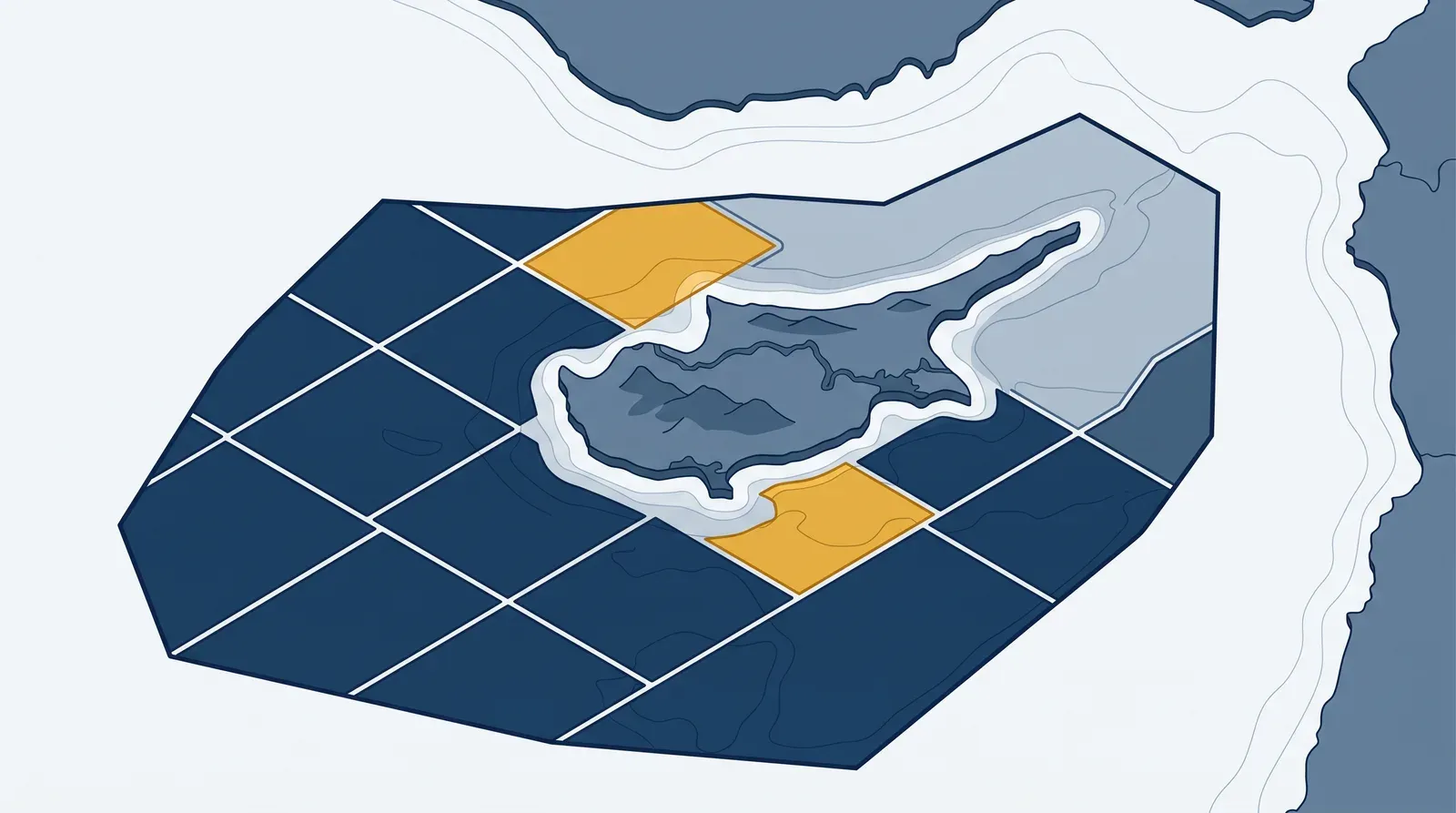
Of the 13 EEZ blocks, 7 are licensed — Blocks 5 and 10 (ExxonMobil/QatarEnergy), Blocks 6, 7, 8 and 11 (Eni/TotalEnergies) and Block 12 (Chevron/Shell/NewMed). Blocks 2, 3 and 9 were relinquished in January 2025 when their exploration terms lapsed and KOGAS exited Cyprus; Blocks 1, 4, 13 have never been licensed.
Cyprus has held three competitive rounds (2007, 2012, 2016) and awarded two blocks by direct application (Block 7 in 2019, Block 5 in 2021). With three blocks open, three relinquished, and the province de-risked by six discoveries, the conditions for a fourth licensing round are accumulating — a decision that sits with the Ministry of Energy under Minister Michael Damianos, with the state's commercial interests managed by the Cyprus Hydrocarbons Company. To date 15 exploration and appraisal wells have been drilled in the EEZ.
2026: The Year in Milestones
Cyprus and Israel reach an in-principle deal resolving the Aphrodite–Ishai unitization dispute via one-time compensation; Leviathan partners take a $2.36 bn FID on Phase 1B next door.
Egypt's EGAS initials a 15-year term sheet for 100% of Aphrodite's output (~700 mmcf/d), to be delivered via a new ~$2 bn subsea pipeline to Port Said.
The Cyprus cabinet approves the Cronos development plan (19 May) — export via a subsea tie-back to Zohr and liquefaction at Damietta LNG, first gas targeted for 2028.
Cyprus, ExxonMobil and QatarEnergy sign the Declaration of Commercial Discovery for the Block 10 fields Glaucus and Pegasus (30 June), moving them into development.
Pegasus appraisal drilling is scheduled for late 2026; Aphrodite FID is targeted for late 2026–2027; Cronos FID is imminent following plan approval.
Regional Context
Cyprus's ~17–18 tcf sits inside the Levantine Basin, which the USGS credits with a mean ~122 tcf of undiscovered recoverable gas. Israel (40+ tcf discovered, led by Leviathan) and Egypt (Zohr, ~30 tcf GIIP) remain the province's heavyweights; Lebanon's first deepwater well disappointed in 2023, and Syrian waters are unexplored.
For Cyprus the regional dynamic cuts both ways: Egyptian infrastructure gives its stranded gas a route to market, but Cypriot volumes queue behind larger Israeli contracts for the same liquefaction capacity. Coordination runs through the East Mediterranean Gas Forum, of which Cyprus is a founding member.
Outlook: What to Watch
These events are tracked live, with status updates as they land, on the Milestones Tracker.
Pegasus appraisal well spuds — the result puts a published figure on the one Block 10 field without one, and with it sizes the hub.
Aphrodite final investment decision. FEED has run since December 2025; the Egypt term sheet removed the last commercial blocker.
Cronos FID and construction start; long-lead subsea orders would confirm the 2028 first-gas target.
First Cypriot gas — Cronos start-up would end the 17-year gap between discovery (2011) and production.
Block 10 hub FID (~2029) and production (~2033); Aphrodite first gas (~2030–31). By the early 2030s Cyprus could have three producing systems, all exporting via Egypt.
Methodology, Sources & How to Cite
This report is compiled from the OilCyprus structured dataset. Its resource figures carry a source reference; the rest of the dataset carries an edit date and no claim of verification. Sources drawn on here: Republic of Cyprus Ministry of Energy, Commerce and Industry announcements, operator disclosures (Chevron, Eni, TotalEnergies, ExxonMobil and partners), the NSAI resource report for Aphrodite (February 2026), EU Official Journal block coordinates, and the USGS Levant Basin Province assessment (2010). Resource figures are labelled by category and never summed across categories. Analysis is AI-assisted and reviewed by Yuri Kan, founder & editor.
The underlying data is freely available: open datasets (GeoJSON/CSV/JSON), an OpenAPI description, and llms-full.txt for AI systems. Content is licensed CC BY 4.0 — reuse with attribution.
Cite this report
OilCyprus (2026). State of Cyprus Gas 2026. Retrieved from https://oilcyprus.com/reports/state-of-cyprus-gas-2026