Levantine Basin
The Eastern Mediterranean's Gas Province
The Levantine Basin is a deepwater sedimentary basin between Israel, Lebanon, Syria, Cyprus and Gaza that has produced the Eastern Mediterranean's defining gas discoveries — Tamar, Leviathan, Aphrodite, and the wave of Cypriot finds that followed. The USGS puts its undiscovered potential at a mean of ~122 Tcf of gas.
What the Levantine Basin Is
The Levantine Basin (also called the Levant Basin) occupies the easternmost corner of the Mediterranean Sea, bounded by the coastlines of Israel, Lebanon, Syria, the Gaza Strip and the island of Cyprus, and grading into the Nile Delta cone off Egypt to the south-west. The US Geological Survey's Levant Basin Province covers roughly 83,000 square kilometres, with water depths reaching beyond 2,000 metres.
For most of the 20th century the basin was written off as a hydrocarbon backwater. That changed in 2009–2011, when three deepwater wells — Tamar (2009) and Leviathan (2010) off Israel, then Aphrodite (2011) off Cyprus — proved a prolific biogenic gas play and opened one of the world's newest gas provinces. Egypt's giant Zohr find (2015) then proved a second, carbonate play on the basin's south-western edge.
In 2010 the USGS estimated the province holds a mean of about 122 trillion cubic feet of undiscovered, technically recoverable gas and about 1.7 billion barrels of oil. Discoveries to date — over 40 Tcf off Israel, roughly 17–18 Tcf off Cyprus, and Zohr's ~30 Tcf GIIP — have gone a long way toward validating that estimate for gas; no commercial oil has been found.
Updated October 2026 · Sources: USGS Levant Basin Province assessment (2010), operator disclosures
Geology: Two Plays Under a Salt Blanket
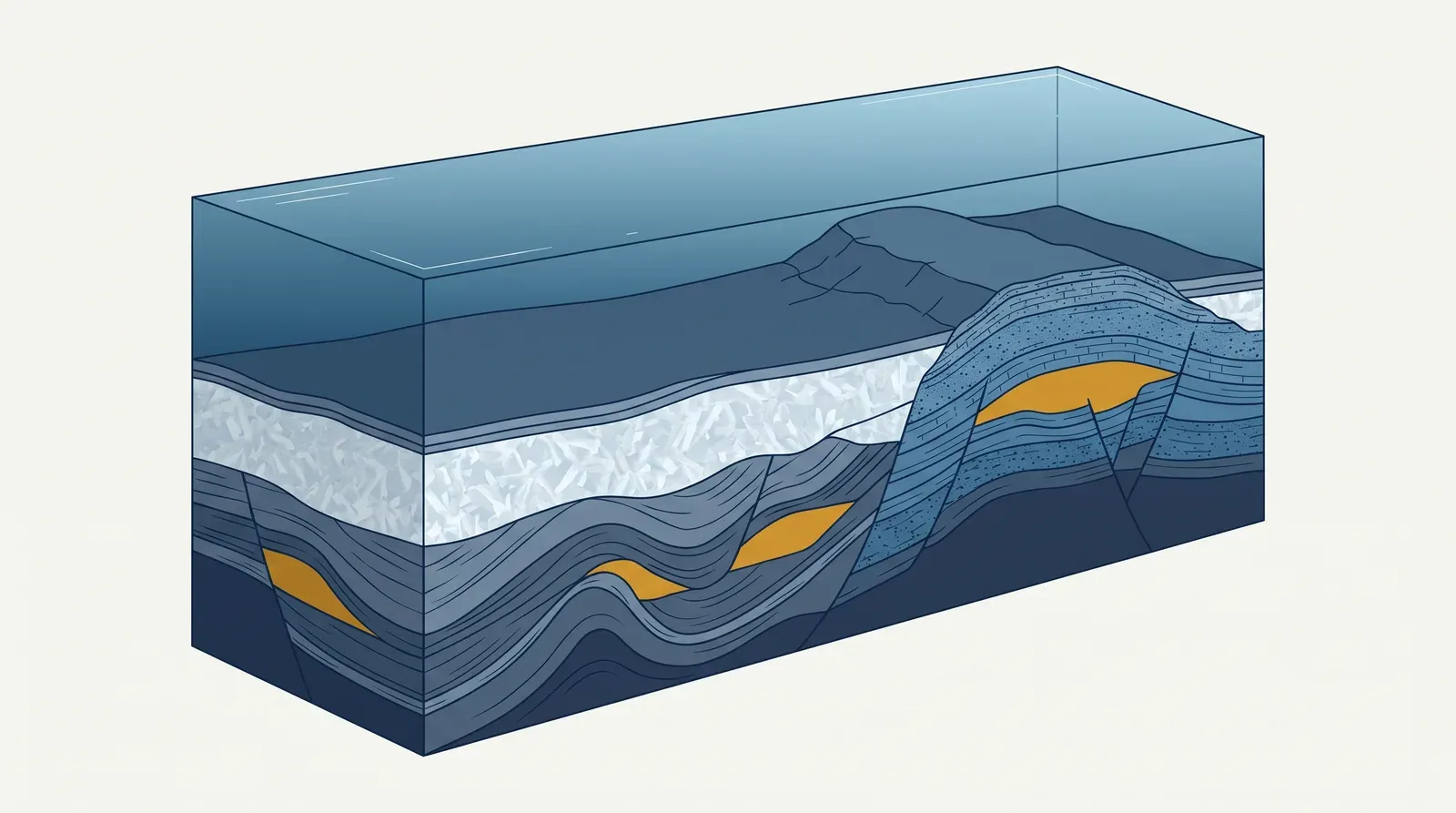
The basin's signature play is the "Tamar sands": Oligocene–Miocene deepwater turbidite sandstones charged with biogenic methane generated at shallow depths by microbial activity, rather than by deep thermal cracking. The reservoirs are sealed beneath a layer of Messinian evaporites — salt up to two kilometres thick, laid down about six million years ago when the Mediterranean largely dried out. Tamar, Leviathan, Aphrodite, Karish, and Cyprus's Glaucus and Pegasus all belong to this play.
The second play emerged with Zohr in 2015: carbonate reef build-ups on the Eratosthenes platform, a drowned continental fragment south of Cyprus. Eni's Cronos and Zeus discoveries in Cyprus Block 6 (2022) proved that this Zohr-type play extends into Cypriot waters — a key reason Eni and TotalEnergies committed to fast-tracked development via Egypt.
Major Discoveries, 2009–2025
| Field | Year | Waters | Size | Status |
|---|---|---|---|---|
| Tamar | 2009 | Israel | ~11.2 Tcf | Producing since 2013 |
| Leviathan | 2010 | Israel | ~22.9 Tcf | Producing since 2019 |
| Aphrodite | 2011 | Cyprus | ~2.9–3.7 Tcf | FEED; first gas ~2030–31 |
| Zohr | 2015 | Egypt | ~30 Tcf GIIP | Producing since 2017 |
| Karish & Tanin | 2013 | Israel | ~2–3 Tcf | Producing since 2022 |
| Calypso | 2018 | Cyprus | ~1 Tcf | Appraisal |
| Glaucus | 2019 | Cyprus | 5–8 Tcf | Commercial declaration 2026 |
| Cronos | 2022 | Cyprus | 3.1 Tcf GIIP | Development approved; first gas ~2028 |
| Zeus | 2022 | Cyprus | Under appraisal | Discovery |
| Pegasus | 2025 | Cyprus | No figure published | Appraisal drilling late 2026 |
Sizes mix recoverable estimates and gas-initially-in-place (GIIP) as reported by operators; they are not additive. Zohr sits on the Eratosthenes carbonate platform at the basin's south-western edge.
Updated October 2026 · Sources: operator disclosures, Cyprus Ministry of Energy, USGS
Who Holds What
Israel is the basin's established producer: Tamar (2013), Leviathan (2019) and Karish (2022) supply the domestic market and growing exports to Egypt and Jordan. Israel's gas sector →
Cyprus holds six commercial-scale discoveries totalling roughly 17–18 Tcf across Blocks 6, 10 and 12, with first production expected around 2028 from Cronos. All Cypriot export routes currently run through Egypt's LNG infrastructure. Cyprus gas fields →
Lebanon settled its maritime boundary with Israel in October 2022, unlocking exploration: TotalEnergies drilled the Qana prospect in Block 9 in 2023 but did not encounter a commercial reservoir. Syria's offshore remains unexplored, and the Gaza Marine field (~1 Tcf, discovered 2000) remains undeveloped.
Regional coordination — including Egypt, Israel, Cyprus, Greece, Italy and Jordan — runs through the East Mediterranean Gas Forum.
Frequently Asked Questions
What is the Levantine Basin?
The Levantine (or Levant) Basin is a deepwater sedimentary basin in the Eastern Mediterranean Sea, bounded by the coasts of Israel, Lebanon, Syria, Cyprus, and the Gaza Strip, covering roughly 83,000 square kilometres. Since 2009 it has yielded a series of major natural gas discoveries — including Tamar, Leviathan, Aphrodite, and the Cyprus Block 6 and Block 10 fields — that turned the Eastern Mediterranean into a significant gas province.
How much gas is in the Levantine Basin?
The US Geological Survey estimated in 2010 that the Levant Basin Province holds a mean of about 122 trillion cubic feet (tcf) of undiscovered, technically recoverable natural gas. Discoveries made since then — over 40 tcf in Israeli waters and roughly 17–18 tcf in Cypriot waters, plus Zohr on the basin's south-western edge — have confirmed the basin as a world-class gas province.
Which countries share the Levantine Basin?
Israel, Cyprus, Lebanon, Syria, and the Palestinian territories (Gaza Marine) all have Levantine Basin acreage in their maritime zones, with Egypt adjoining the basin to the south-west. Israel and Cyprus have made the largest confirmed discoveries; Lebanon's first deepwater well at Block 9 (Qana prospect, 2023) did not find a commercial reservoir, and Syrian waters remain essentially unexplored.
Is there oil in the Levantine Basin?
The same 2010 USGS assessment estimated a mean of about 1.7 billion barrels of undiscovered, technically recoverable oil in the Levant Basin Province, but no commercial oil field has been found to date. Every commercial discovery so far is natural gas — the basin's deepwater plays are gas-prone, dominated by biogenic gas in Oligocene–Miocene sandstones.
What makes the geology of the Levantine Basin special?
Most discoveries sit in Oligocene–Miocene deepwater sandstone reservoirs (the "Tamar sands") charged with biogenic methane and sealed beneath a thick layer of Messinian salt deposited when the Mediterranean partially evaporated around six million years ago. A second play type — carbonate build-ups like the one holding Egypt's Zohr field — extends onto the Eratosthenes platform south of Cyprus, where Eni's Cronos and Zeus discoveries proved the same play in Cypriot waters.